A guided tour of St Peter’s Basilica
At the heart of the Vatican lies St Peter’s Square, an open space designed by Bernini in the 17th century, which leads to the nerve centre of the papal city: St Peter’s Basilica. In this square, surrounded by 284 columns and 140 statues of saints, it is possible to hold services for more than 300,000 people. This is the ideal starting point for exploring the Vatican. Today we’re taking you on a brief tour of St Peter’s Square and St Peter’s Basilica so that you don’t miss a single detail during your visit.
A guided tour of St Peter’s Basilica
At the heart of the Vatican lies St Peter’s Square, an open space designed by Bernini in the 17th century, which leads to the nerve centre of the papal city: St Peter’s Basilica. In this square, surrounded by 284 columns and 140 statues of saints, it is possible to hold services for more than 300,000 people. This is the ideal starting point for exploring the Vatican. Today we’re taking you on a brief tour of St Peter’s Square and St Peter’s Basilica so that you don’t miss a single detail during your visit.
A brief history of St Peter’s Square and St Peter’s Basilica
The history of St Peter’s Basilica dates back to the 4th century, when Constantine decided to build a place of worship on the site where the apostle St Peter had been buried.
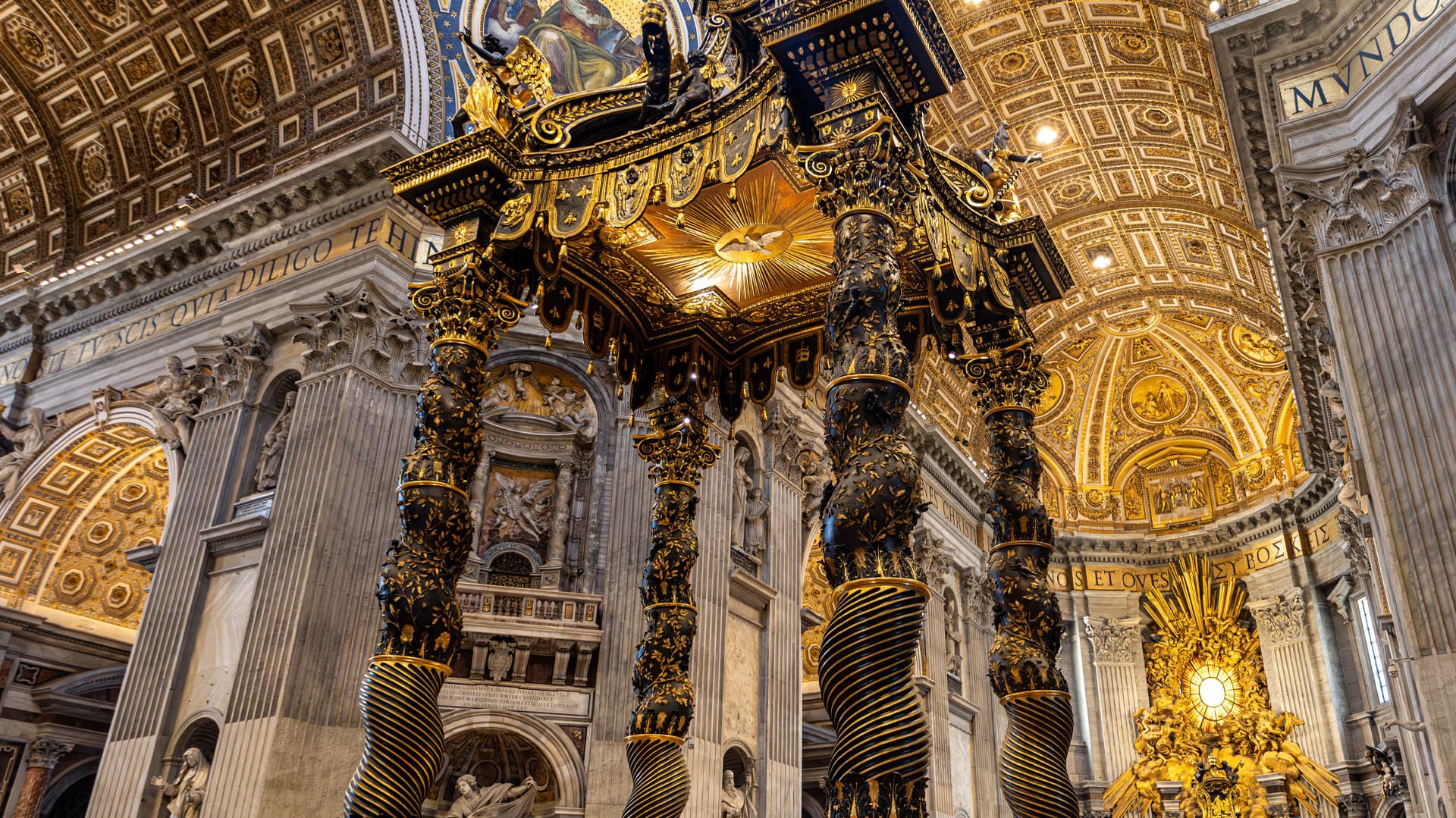
However, that original building was replaced by the present-day Basilica on the orders of Pope Julius II, between 1506 and 1629. Various architects worked on this project, including Donato Bramante, Raphael, Antonio da Sangallo and Michelangelo, who gave the design its final form. The interior, meanwhile, was decorated by Bernini.
Furthermore, St Peter’s Square was built between 1656 and 1667 by Bernini and his disciples, under the direction of Pope Alexander VII, with the aim of providing a space to accommodate the visitors who gathered to receive the pontiff’s blessing. Its central obelisk, columns and 140 statues of saints invite visitors to explore the square and take in every detail, given their significant symbolism and religious meaning.
Today, St Peter’s Basilica is the largest in the world, with a total area of 23,000 square metres, which takes several hours to visit. Given the wealth of detail within these spaces, we recommend taking a guided tour of the Vatican so you don’t miss a single detail.
Key works of art you’ll see on your visit to St Peter’s Basilica
Over the course of its centuries-long history, St Peter’s Basilica has become not only the world’s foremost ecclesiastical church, but also a major artistic venue housing works of great significance in the history of world art.
The Pietà in the Vatican by Michelangelo Buonarroti (1499)
This marble sculpture by Michelangelo is the highlight of any visit to St Peter’s Basilica, and one of the finest sculptures of the Italian Renaissance. It depicts the Virgin Mary, draped in robes with striking folds, holding the body of her son.
The level of detail in the facial expressions, the bodies and the clothing is particularly striking, as is the age at which the artist sculpted this masterpiece: Michelangelo was between 23 and 25 years old when he created it.
The artwork is located in the Chapel of the Crucifix, immediately on the right as you enter, and is in itself a compelling reason to book tickets for St Peter’s Basilica.
Bronze statue of St Peter attributed to Arnolfo di Cambio (1300)
On the right-hand side of the central nave stands another of the Basilica’s principal sculptures: the statue of Saint Peter the Apostle, also known as ‘The Fisherman’ and attributed to Arnolfo di Cambio. Unlike most of the sculptures in the complex, which were created during the Renaissance, this bronze work was sculpted in the Middle Ages.
If you visit the Basilica and the Vatican Museums on the feast day of the Saint (29 June) or on the Feast of the Chair of St Peter (22 February), you will see it adorned with papal regalia, as a mark of celebration for the man recognised as the first Pope in history.
Tomb of Alexander VII by Gian Lorenzo Bernini (1678)
Like many other ecclesiastical buildings around the world, figures linked to its history are buried within St Peter’s Basilica. As this basilica is the principal church of the Catholic Church and the seat of the Vatican City State, most of the papal tombs are located within this church, many of them accompanied by impressive sculptures.
The altar of Alexander VII is one of the most striking. Created by Bernini, it is situated at the front of the Basilica, in the left-hand aisle. In it, the Pontiff is masterfully depicted surrounded by representations of the Theological Virtues: charity, truth, prudence and justice.
These are just some of the sculptures you’ll come across during your tour of St Peter’s Basilica. To ensure you don’t miss a single detail and to make your visit a truly rewarding and enjoyable experience, we recommend booking one of our Private tours of the Vatican Museums with specialist guides.