What do the frescoes in the Sistine Chapel mean?
The German writer Goethe wrote: “Without having seen the Sistine Chapel, one cannot form a proper idea of what human beings are capable of achieving.” And how right he was. This room, one of the world’s most famous artistic spaces, is a sublime aesthetic experience that stands out during a tour of the Vatican Museums. And it is impossible to think of the Sistine Chapel without considering the figure of Michelangelo Buonarroti. He himself said that “perfection is no small thing, but it is made up of small things”; a perfection he sought in his masterpiece through his various frescoes. Read on to find out more about the works of art that adorn the Sistine Chapel.
What do the frescoes in the Sistine Chapel mean?
The German writer Goethe wrote: “Without having seen the Sistine Chapel, one cannot form a proper idea of what human beings are capable of achieving.” And how right he was. This room, one of the world’s most famous artistic spaces, is a sublime aesthetic experience that stands out during the tour of the Vatican Museums.
And it is impossible to think of the Sistine Chapel without considering the figure of Michelangelo Buonarroti. He himself said that “perfection is no small thing, but it is made up of small things”; a perfection he sought to achieve in his masterpiece through his various frescoes. Read on to find out more about the works of art that adorn the Sistine Chapel.
The frescoes of the Sistine Chapel
The ceiling of the Sistine Chapel was painted solely by Michelangelo (Miguel Ángel in Spanish) at the request of Pope Julius II between 1508 and 1512. Due to the difficulty of the surface on which the work was painted and the fact that the artist carried out the work alone, the creation of these frescoes is considered in itself an impressive artistic feat.
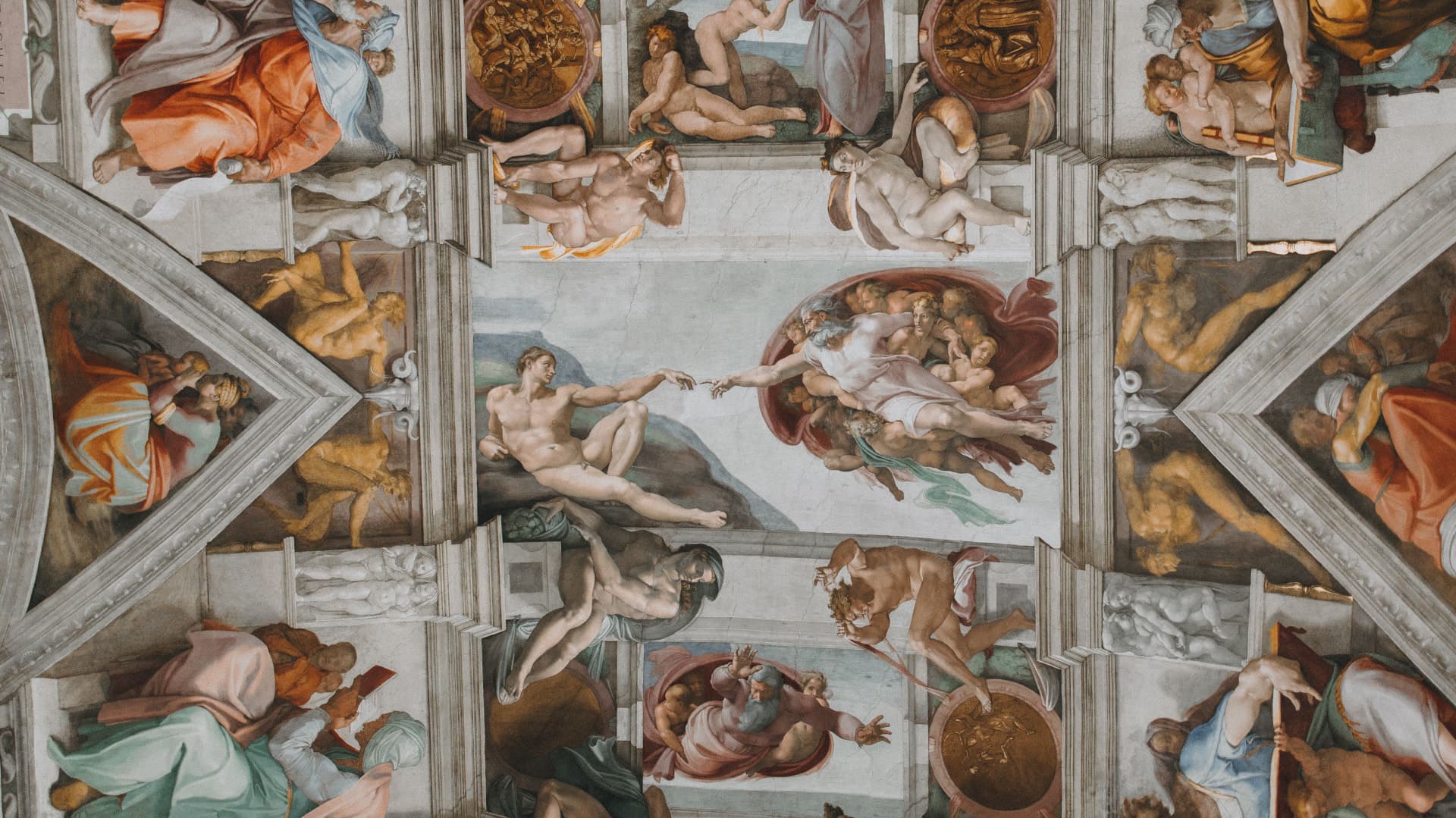
The ceiling is divided into nine panels, depicting scenes from the Book of Genesis. In other words, they depict the story of the creation of the world according to the Catholic Church.
The various panels are dedicated to:
- The separation of light and darkness
- The creation of the Sun, the Moon and the planets
- The separation of land and sea
- The Creation of Adam
- The Creation of Eve (central panel)
- The Expulsion from Paradise
- The Sacrifice of Noah
- The Great Flood
- Noah’s Drunkenness
In turn, these panels are accompanied by figures of the prophets (Zechariah, Joel, Isaiah, Ezekiel, Daniel, Jeremiah and Jonah) and the sibyls (Delphic, Eritrean, Cumana, Persian and Libyan), making it a fusion of Christian and pagan elements. This feature makes Michelangelo’s work all the more fascinating, and you can admire it with your tickets to the Sistine Chapel.
And as if all this were not enough, the four stories of Israel’s salvation are depicted in the corners of the ceiling, completing a work that is as beautiful as it is complex and which deserves to be spent some time admiring during your tour of the Vatican Museums so that you can appreciate it in its entirety.
The most important work in the Vatican Museums
Among all the sections that make up the vault of the Sistine Chapel, ‘The Creation of Adam’ stands out as one of the most widely recognised artistic images in the world, making it well worth buying tickets for the Vatican Museums and the Sistine Chapel. In this section, Adam can be seen reclining languidly on the left, and the figure of God on the right.
Although this fresco appears symmetrical at first glance, a closer examination of the positions and postures of both figures reveals that this is not the case. This demonstrates that Michelangelo was not only a magnificent sculptor, but also knew how to depict figures and their movement on a two-dimensional plane.
Another interesting feature of this fresco is that it also includes the figure of Eve in the background: she is beneath God’s arm, protected and waiting her turn to be created.
Due to the size of the fresco, and the height between the floor and the vaulted ceiling, it is difficult to make out all the details of these frescoes. For this reason, we recommend that you take the guided tour of the Vatican Museums accompanied by a specialist guide. Discover our options and book your place today.